Pilates for Osteoporosis: What Your Bones Actually Need to Stay Strong
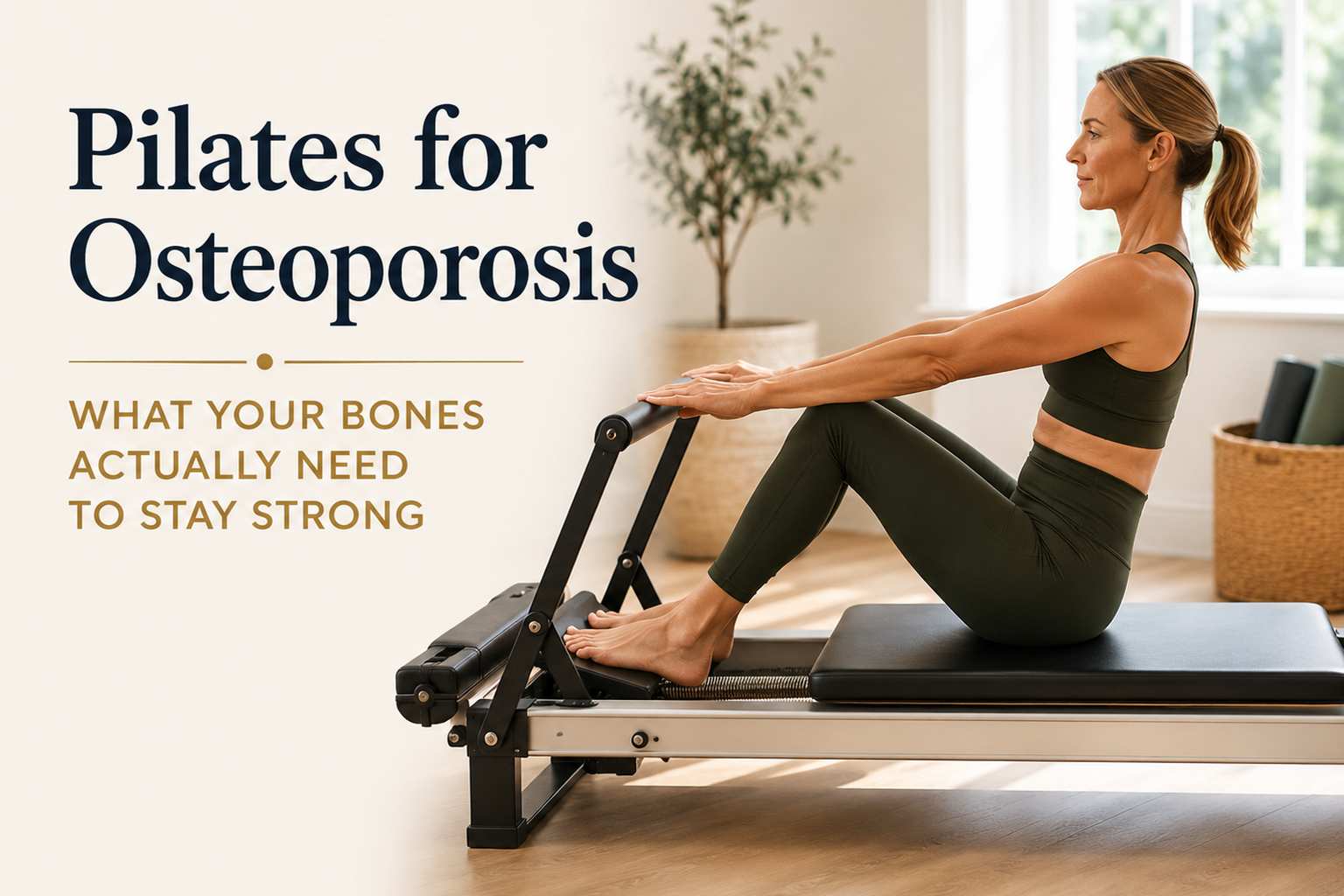
Osteoporosis isn't only about calcium, bone health is closely connected to hormones, muscle strength and mechanical loading. Discover how menopause affects bone density and why Reformer Pilates, progressive resistance, Footwork, balance and strength can become powerful parts of maintaining stronger bones and an active body as we age.
Most women think of osteoporosis as a calcium problem.
Bones get weaker, so we need more calcium. Simple, right?
Not quite.
Bone is living tissue. It is constantly being broken down and rebuilt, and one of the most important signals telling your body to maintain strong bones is something we don't talk about enough:
Load.
This becomes especially important during perimenopause and menopause, when changes in estrogen affect not only our bones, but our muscles, joints and connective tissues too.
So if we really want to understand osteoporosis- and how Pilates can help- we need to look at the entire system.
What Happens to Our Bones During Menopause?
Throughout our lives, bone is continuously remodeled. Old bone is broken down by cells called osteoclasts, while new bone is formed by osteoblasts.
Estrogen helps regulate this balance.
As estrogen fluctuates during perimenopause and eventually remains much lower after menopause, bone breakdown can begin to outpace bone formation. Over time, bone mineral density decreases.
The early stage is called osteopenia. More significant bone loss may eventually become osteoporosis, increasing the risk of fractures.
And here's the dangerous part:
You usually can't feel bone loss happening.
Osteoporosis is often called a “silent disease” because declining bone density typically doesn't hurt. That's why waiting for symptoms isn't a good bone-health strategy.
But This Isn't Only About Your Bones
At the same stage of life, another important change may be happening:
We can begin losing muscle mass and strength.
Muscle does far more than change how our body looks.
It stabilizes our joints, controls movement, supports balance and helps us manage the forces created during everyday activities.
And muscle and bone are physically connected.
When a muscle contracts against resistance, it pulls through its tendon onto bone. Those forces create mechanical signals that bone tissue can respond to.
In other words:
Strong muscles don't just move your skeleton. They help give your skeleton a reason to stay strong.
Your Bones Need a Reason to Adapt.
Walking is wonderful for cardiovascular health, mobility and overall wellness.
But when we're specifically talking about building stronger bones, movement alone may not provide enough stimulus.
Research supports progressive resistance training and, when appropriate for the individual, impact exercise as important tools for bone health.
One important example is the LIFTMOR randomized controlled trial involving postmenopausal women with low bone mass.
After eight months, women performing supervised high-intensity resistance and impact training significantly improved lumbar-spine bone mineral density compared with women following a low-intensity home exercise program.
The lesson isn't that every woman with osteoporosis should suddenly lift extremely heavy weights.
It's this:
Bone responds to appropriate mechanical challenge.
So, Is Pilates Good for Osteoporosis?
Pilates can play an important role because we're not training the bones in isolation.
A well-designed Pilates program can develop strength, resistance, balance, coordination, posture and body awareness—all extremely important as we age.
On the reformer, we also have something particularly valuable:
Adjustable resistance.
We can modify springs, positions, range of motion and exercises according to the person in front of us and progressively challenge the body as it becomes stronger.
Why Reformer Footwork Matters
One of the fundamental principles of bone health is mechanical loading: bone responds to the forces placed upon it.
This is one reason Reformer Footwork is much more than a warm-up.
Your feet press firmly into the footbar while the springs create resistance. To move the carriage, the muscles of the legs and hips have to generate force- your quadriceps, hamstrings, glutes and calves participate while the pelvis and trunk work to maintain control and alignment.
Then comes the equally important part: controlling the carriage as it returns.
Press. Resist. Control. Return.
With every repetition, the lower body works against external resistance rather than simply moving through space.
And because the reformer is adjustable, the challenge doesn't have to remain the same.
As strength improves, we can modify resistance, range, tempo, position and exercise variation.
That principle is called progressive loading.
It gives muscles a reason to become stronger and exposes the skeleton to mechanical forces—an important part of maintaining bone health.
Footwork also trains the relationship between the feet, ankles, knees, hips and pelvis—the same system that supports us when we stand, walk, climb stairs, get out of a chair or recover our balance.
We're not simply “working the legs.”
We're training the system that supports us against gravity every single day.
Stronger Bones Are Only Half the Goal
When we talk about osteoporosis, we tend to focus entirely on bone density.
But there's another side of fracture prevention:
Preventing falls.
Strong legs help us climb stairs and control our bodies when we lose balance. Strong hips help stabilize the pelvis. Good proprioception helps the brain understand where the body is in space.
This is another reason Pilates can be so valuable as we age.
We're not only training a bone.
We're training the entire system that protects it.
What About Calcium?
Calcium matters. So do vitamin D, adequate protein and overall nutrition.
But nutrition and exercise have different jobs.
A simple way to think about it is:
Nutrition provides the building materials.
Training provides the stimulus.
Depending on bone density, medical history and fracture risk, some women will also need medical treatment. Exercise should work alongside appropriate medical care, not replace it.
The Goal Isn't to Protect Your Body From Load
It's to prepare your body for it.
One of the biggest mistakes we can make as we get older is assuming our bodies should do less and less because they are becoming fragile.
Our bodies need reasons to maintain their abilities.
Muscle responds to resistance. Bone responds to load. Balance improves when we practice balance. Strength improves when we ask the body to become stronger.
At Haven Pilates, we don't believe Pilates is valuable simply because it's “gentle.”
We believe in purposeful movement, intelligent resistance and appropriate progression.
Sometimes that starts with something as simple as putting your feet on the footbar and pressing.
But the bigger goal is much more important:
Building a body strong enough to keep carrying you through the life you want to live.